Jewelled horn: an unexpected material
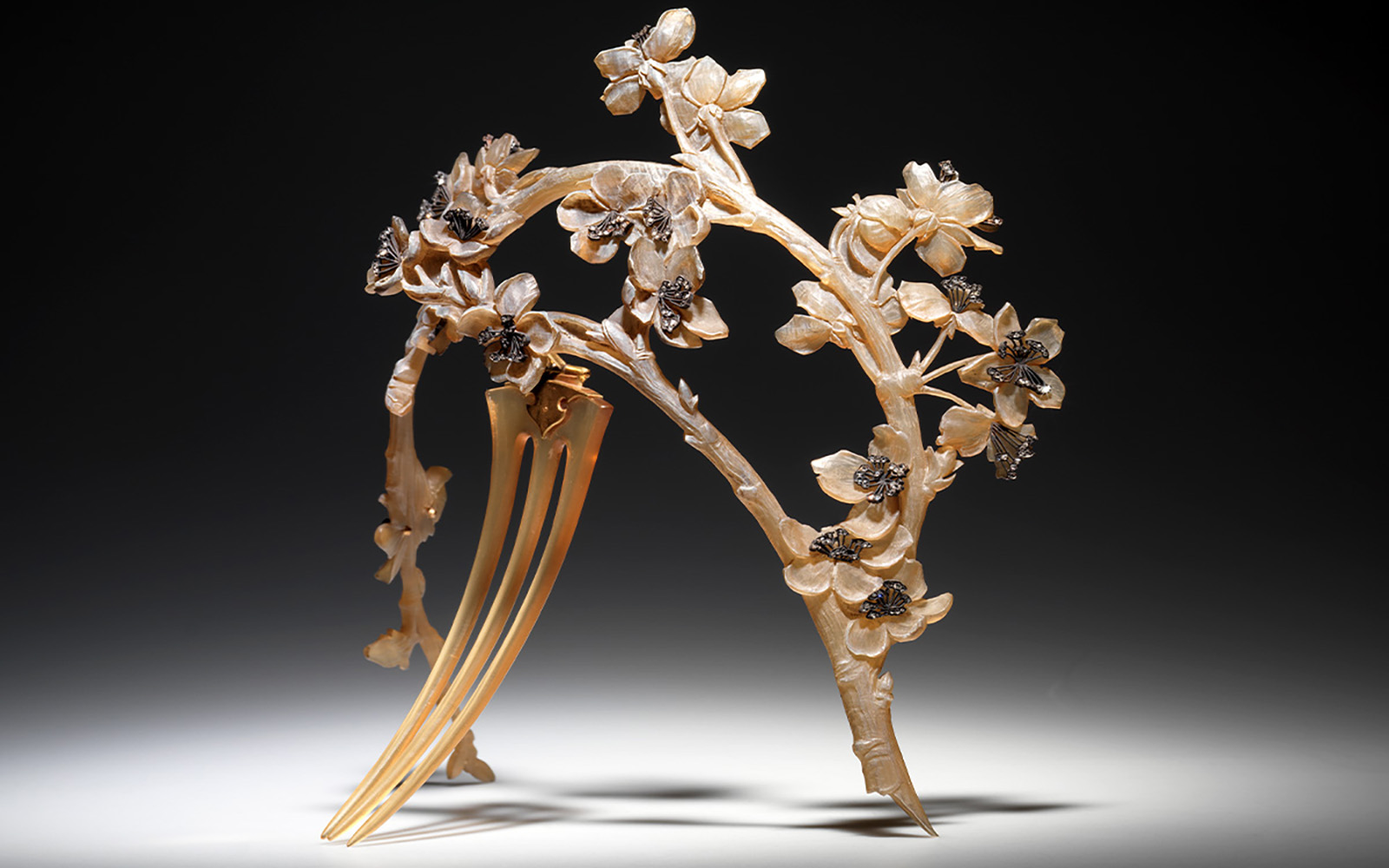
Horns and antlers have probably been used in jewellery since prehistory as available, easy to work and versatile materials. Although ivory has always been highly valued, more humble forms of animal horn really found their moment in the Art Nouveau jewellery of the end of the 19th century, when artistry became more important than conventional preciousness or ideas of financial value. Jewelled and carved horn became the unexpectedly glamorous material for some of the most delicate and beautiful Art Nouveau jewels.
‘A capital value out of waste materials’
In 1900, the Jeweller and Metalworker trade journal reported on René Lalique’s jewellery at the Paris International Exhibition. His jewellery was admired for its outstanding artistry and overall design, but the critic also remarked on the low value of its constituent materials, in particular, the thin flakes of opal used in his jewels. According to the journal: ‘This artist is showing us how to make a capital value out of waste materials’. Alongside opal, horn was a material where the skill in carving and setting it far outweighed its low cost.
Horn had been used as a practical material to make the teeth of combs but Art Nouveau jewellers transformed it into a jewellery material in its own right, appreciated for its unique qualities and possibilities.
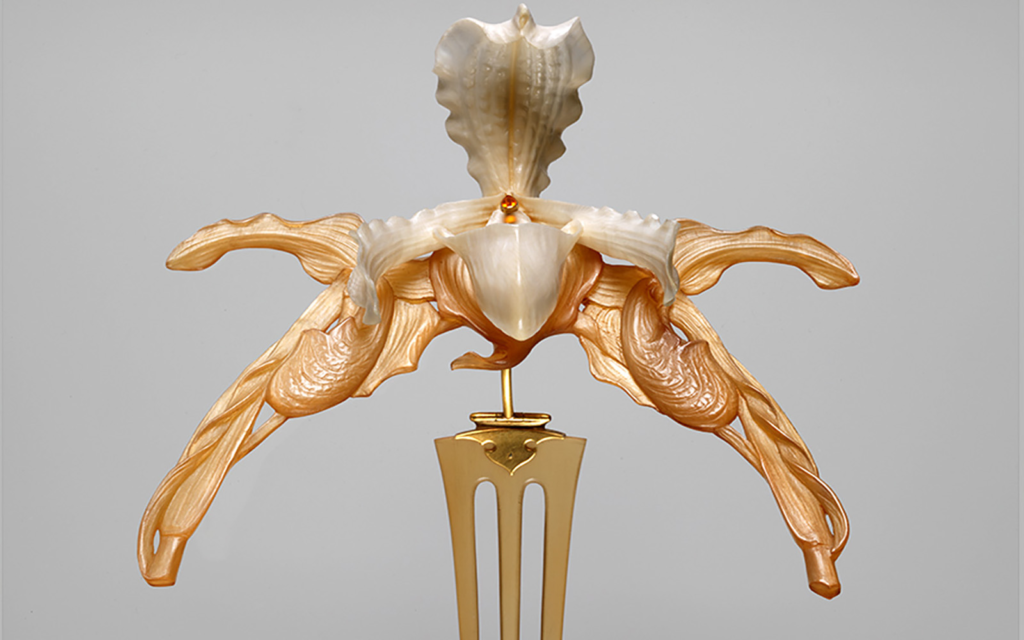
Lalique wanted to make ‘something never seen before’, as he confided to his fellow jeweller and historian Henri Vever. He also had a love and appreciation of nature which shone through his work. Lalique observed nature closely, sketching and photographing but also designing directly from natural specimens. Japanese art, arriving with thunderous effect in the Western world from the 1860s, was also deeply influential. Lacquerwork, woodblock prints, kimonos and other Japanese artworks decorated with plants, insects and flowers were transformed into Art Nouveau jewels.
The artistic refinement of horn
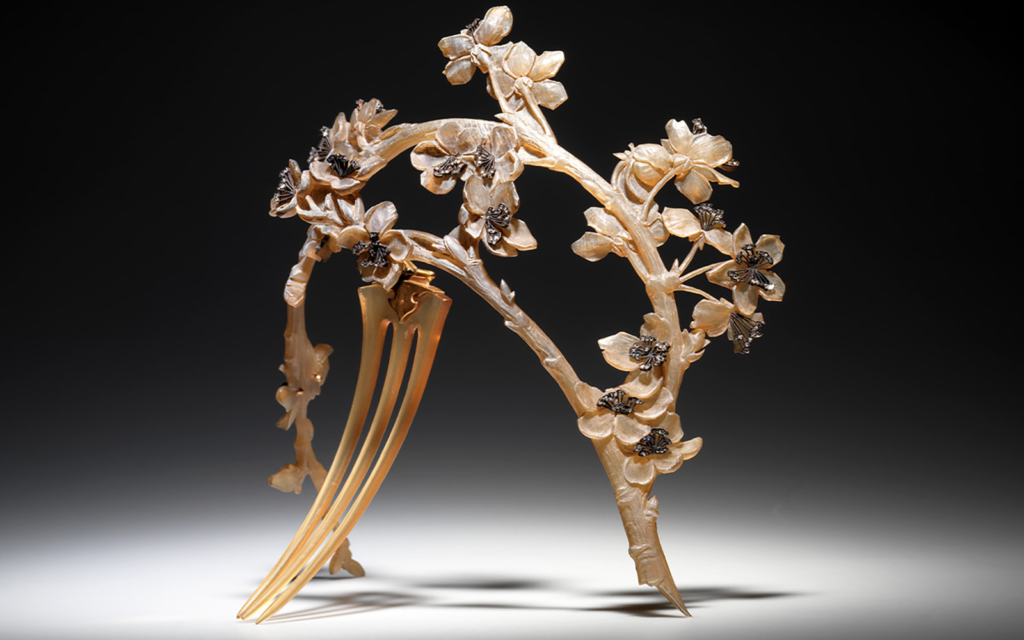
Lalique was credited with the introduction of horn into fine jewellery at the 1896 Paris Salon, winning a second-class medal for his bracelet, but other jewellers soon adopted it.
In 1908, Henri Vever claimed that the new style of jewellery ‘could by the beauty of its craftsmanship, the artistic refinement of its form and design, exceed in value the precious materials used in gem set jewellery’.
Horn was the perfect example of this. It was cheap and easy to obtain – Lalique is said to have experimented with horn bought from a slaughterhouse – and could be carved with fine detail. It was light enough for large pieces to be worn comfortably and when carved could have a pleasing translucency and range of colours.
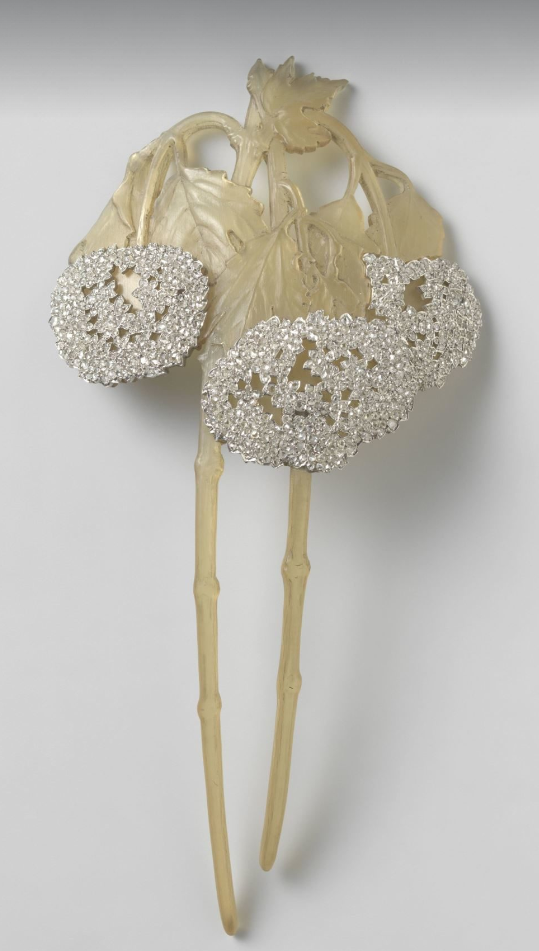
Horn became the ideal match for the naturalism of Lalique’s jewellery. A hair comb, modelled on the Viburnum opulus Roseum or snowball tree, is a delicate creation of carved horn, with translucent veined leaves forming a backdrop to the diamond flowers. The curvature of the horn shapes two hair pins, acting as the stems of the flowers.
Large decorative haircombs were enormously fashionable and horn was the perfect material, light and easy to wear but able to be shaped into elegant and striking sculptural objects.
Horn and diamond hair comb, René Lalique, 1902-3. Rijksmuseum, Amsterdam
According to Vogue magazine account of the 1908 Paris salons:
‘Fashions in jewelry have made a decided departure in recent years. It is not enough that the jewel box contains gold and diamonds. Any metal may now be worn, if it be properly worked by the hand of an artist, and diamonds are, artistically speaking, nothing, unless they are combined with some wonderful bit of color – it may be nothing more than horn or greenish copper.’
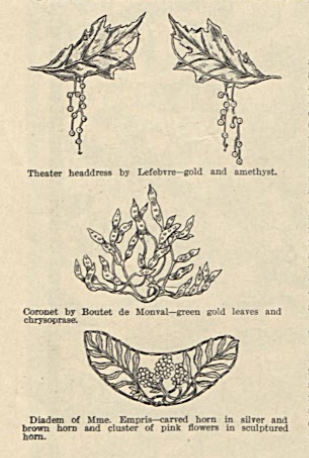
Vogue went on to explain that ‘Horn is immensely used, carved with a master’s hand and combined with gems of price’. For these early twentieth century jewellers, horn was a material appreciated as much as traditional gems and precious metals and ennobled by the artistry of its treatment.
The illustrations to the article include Mme. Empris’ ‘entirely round diadem in carved horn in silvery green and pale brown, a cluster of pink flowers in sculptured horn in the centre of the front’ as well as another horn comb carved and inset with ‘dark terracotta sea shells, tiny spiral shells that were most lovely’.
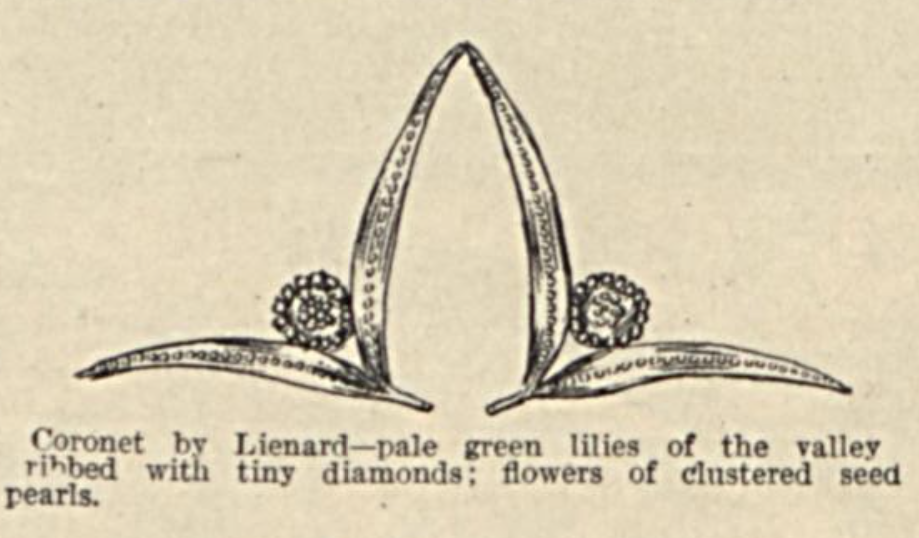
Paul Lienard also used horn to sculpt the leaves of his elegant lily of the valley coronet with diamond and seed pearl flowers.
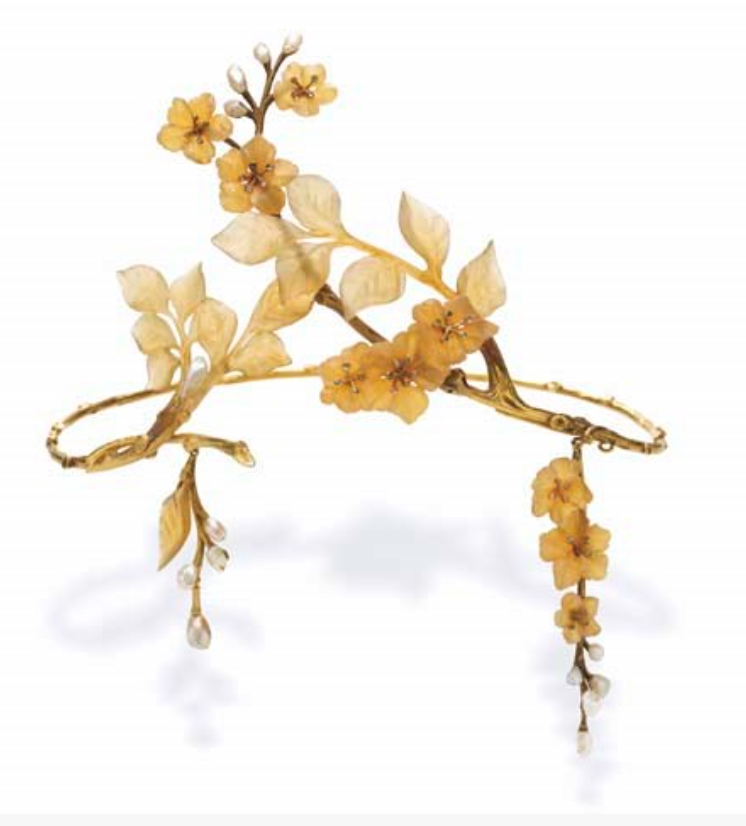
Lienard also took inspiration from plants in his 1900 apple blossom diadem. Textured gold forms the branch like diadem hoop while the translucent horn blossom is set with diamond pistils. Irregularly shaped baroque pearls morph into buds.
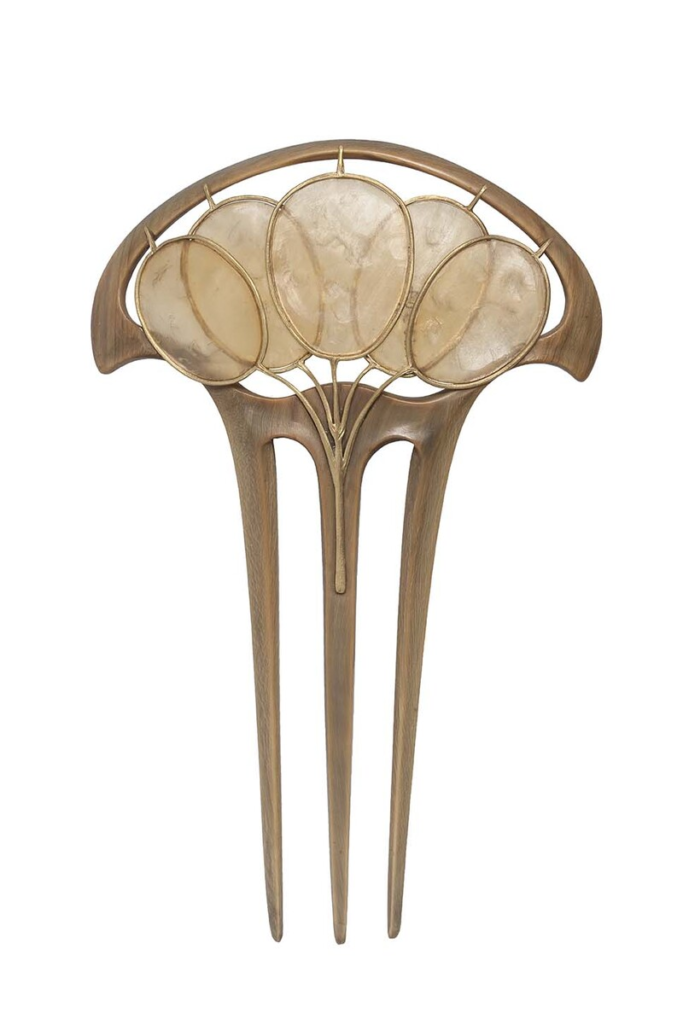
Lucien Gaillard exploited horn’s lightness and translucency in his 1902 comb, now in the Musée des Arts Décoratifs, Paris. It was based on the seed pods of the honesty plant or monnaie du pape and the papery seed pods have been carved out of thin slices of horn, morphing into the form of the haircomb.
The wings of Gaillard’s battling dragonflies were also made of pale coloured horn, carved paper thin and set on bright enamelled bodies. The naturalism and sense of danger were directly inspired by the Japanese art brought to wider attention by Siegfried Bing’s influential publication and shop ‘L’Art Nouveau’.
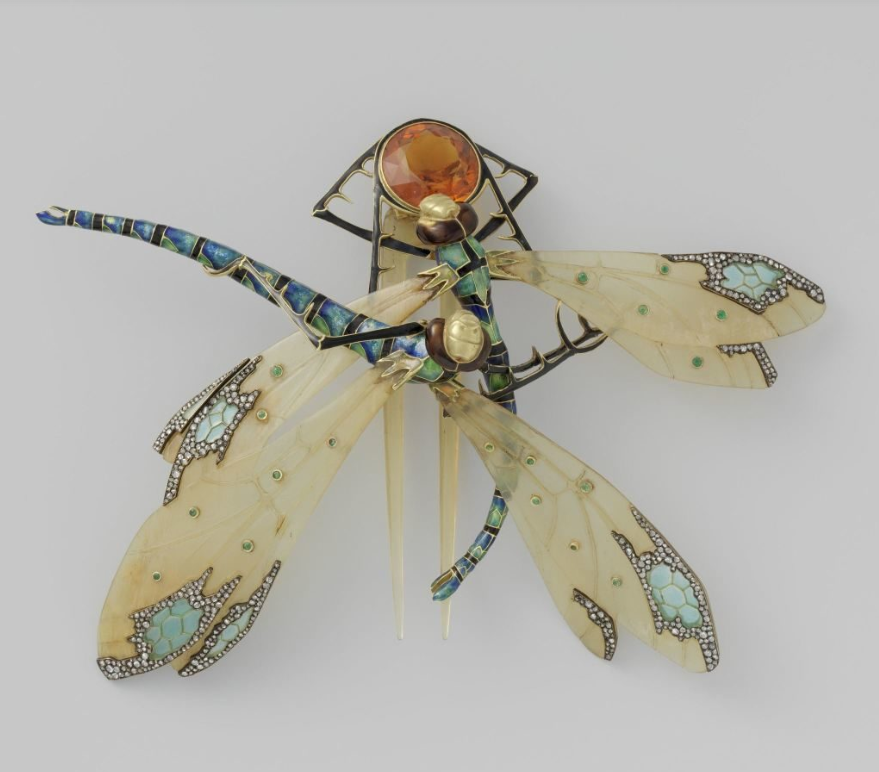
Although horn was a cheap material it still required skill and time to work it successfully. Craftsmen soaked pieces of horn in water and then shaped it under heat and pressure. It was cut to the desired dimensions and pressed into wooden or metal moulds to form it. Delaminating horn into its individual growth layers produced the paper thin pieces used in much Art Nouveau jewellery.
For more unusual materials in jewellery: Making jewellery in a time of war: unusual materials
