How to fake a mocha stone (or moss agate)
Jewellers have long appreciated gemstones for their bright colours, hard surfaces and the way in which they can be shaped and faceted but less conventionally precious stones have their own charms. Moss agates, sometimes known as dendritic agates or historically as mocha stones, have pretty plant like patterns which look like little landscapes or ferns. Polished and set into jewellery or small luxury objects they offer a unique charm. However, sometimes nature failed to provide the perfect stone and in those cases, jewellers came up with some ingenious alternatives.
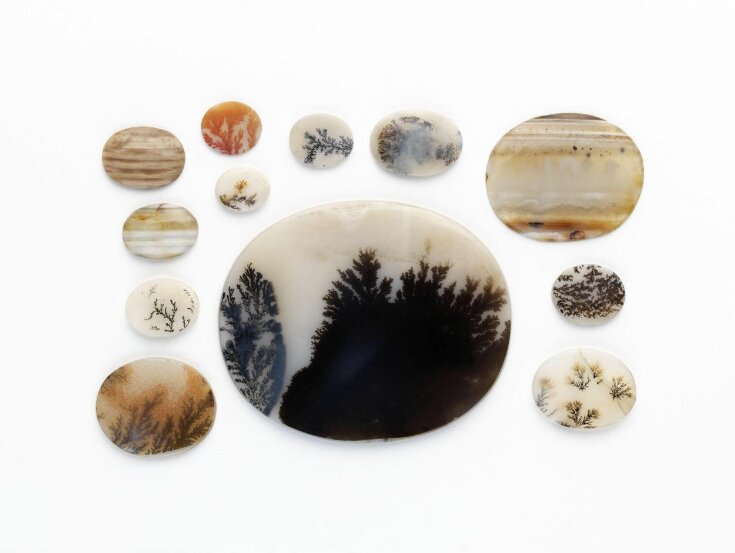
What is a moss agate?
Agate is a micro or cryptocrystalline quartz, in which microscopically small crystals form in layers, often with a great variety of colours. The naturally occurring designs found in dendritic and moss agates are created by iron or manganese oxides which organise themselves into vegetative shapes.
Moss agates, historically known as mocha stones, attracted much interest in the 18th century from collectors of natural history specimens as well as for jewellery and luxury objects. Samuel Johnson’s 1755 Dictionary lists the mocha stone or moss agate as ‘related to the agat, of a clear horny grey, with delineations representing mosses, shrubs, and branches, black, brown, and red in the substance of the stone’
Early naturalists and antiquaries were puzzled about the moss agate’s very natural looking inclusions. They believed that they were created from vegetation impressed into the stone, like a fossil or a fly trapped in amber. In Johann Eber’s 1796 English-German dictionary, the stone is described as a ‘Dendrite, Dendrophore, a Stone on which first several Mosskinds were impressed, which after its Mouldering left several Figures behind.’
Moss agates were originally imported into Europe from India, via the Yemen port of Mocha (al Mukha) from which they may take their alternative name. They are also found in Scotland, around Balmerino in North Fife and became part of the Victorian fashion for ‘pebble jewellery’.
Jewels, chatelaines and snuff boxes were set with moss agates shaped into translucent polished panels. They became the bezels or rings, were set in brooches or necklaces and pieced together into watchcases, chatelaines and gold boxes. These wonders of nature were intended to surprise and impress.
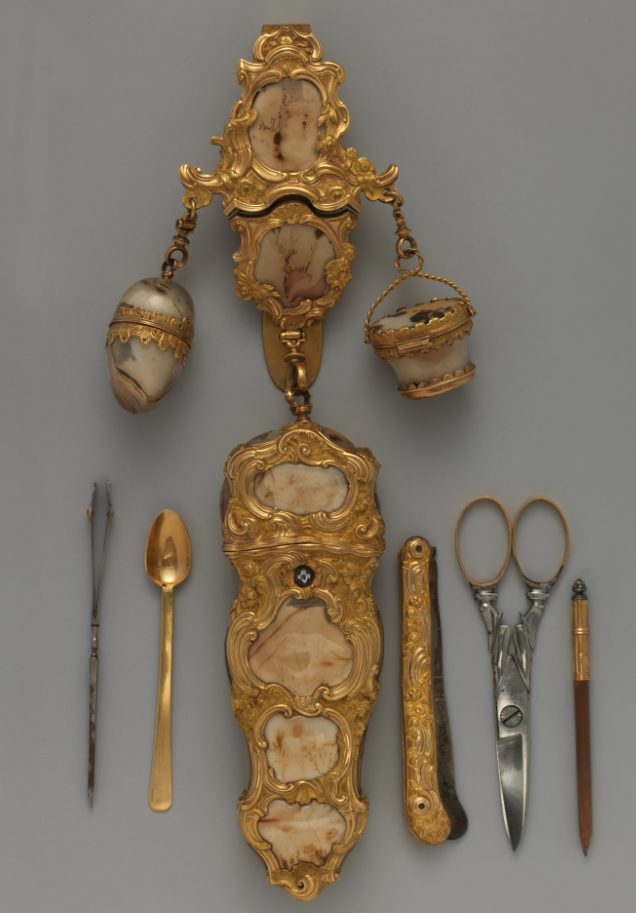
Chatelaines were highly prized personal accessories. Women used them to hold small items like nail files, scissors, thimbles and other little objects needed in daily life. They hung from the belt and were often very decorative and made of luxurious materials. This gold chatelaine from around 1750, now in the Metropolitan Museum of Art, has a framework of asymmetric rococo goldwork around panels of moss agate cut to show off the plant like patterns.
The natural decoration of the moss agate was the perfect complement to the organic shapes of rococo design.
Moss agate was a popular addition to 18th and 19th century jewelled objects and continued to be so into the 20th century.
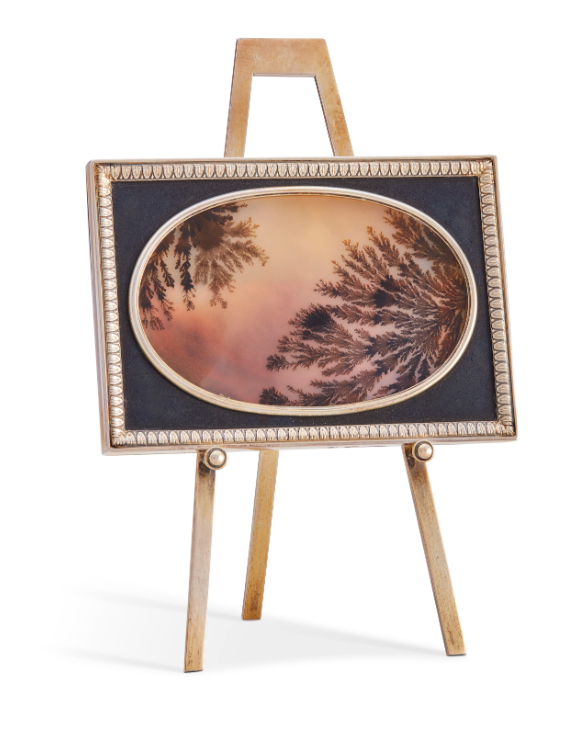
The Russian jeweller Carl Fabergé valued many sorts of precious and semi-precious gemstones for the jewellery and objets d’art he created for the royal courts of Europe. Moss agate, sometimes set over foil to enhance the colour was the key element of cigarette cases, watches, cuff links and small decorative objects.
In this piece, he has used the picture like quality of moss agate to make a little easel on which sits a piece of agate, framed like an oil painting and looking like a landscape at sunset.
How to fake a moss agate
Every naturally created moss agate was different – the colour, pattern and size dictated by its geological formation. However, sometimes jewellers didn’t have access to the right stones or needed more consistency. In these cases, they looked for alternatives.
Faking a moss agate in enamel
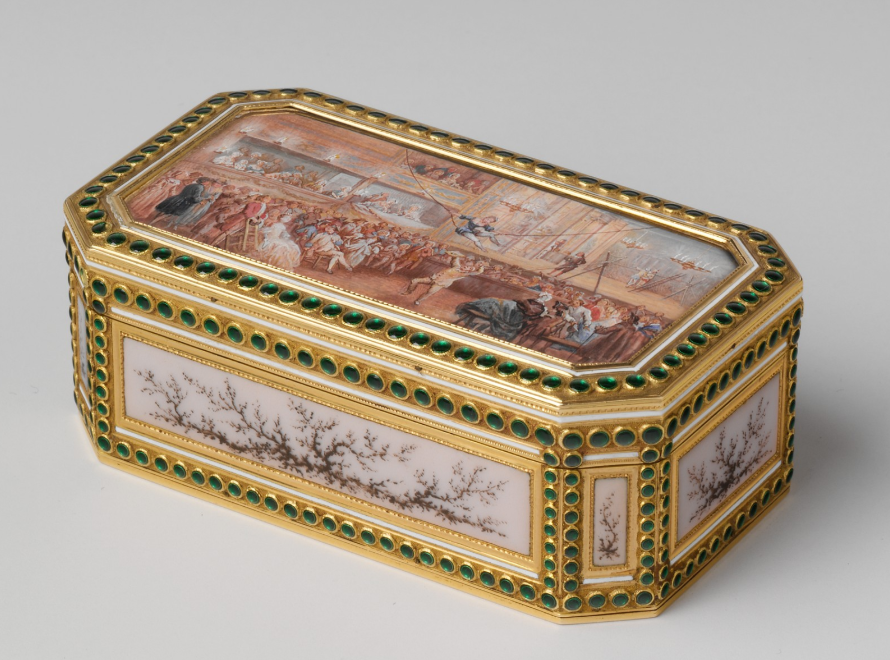
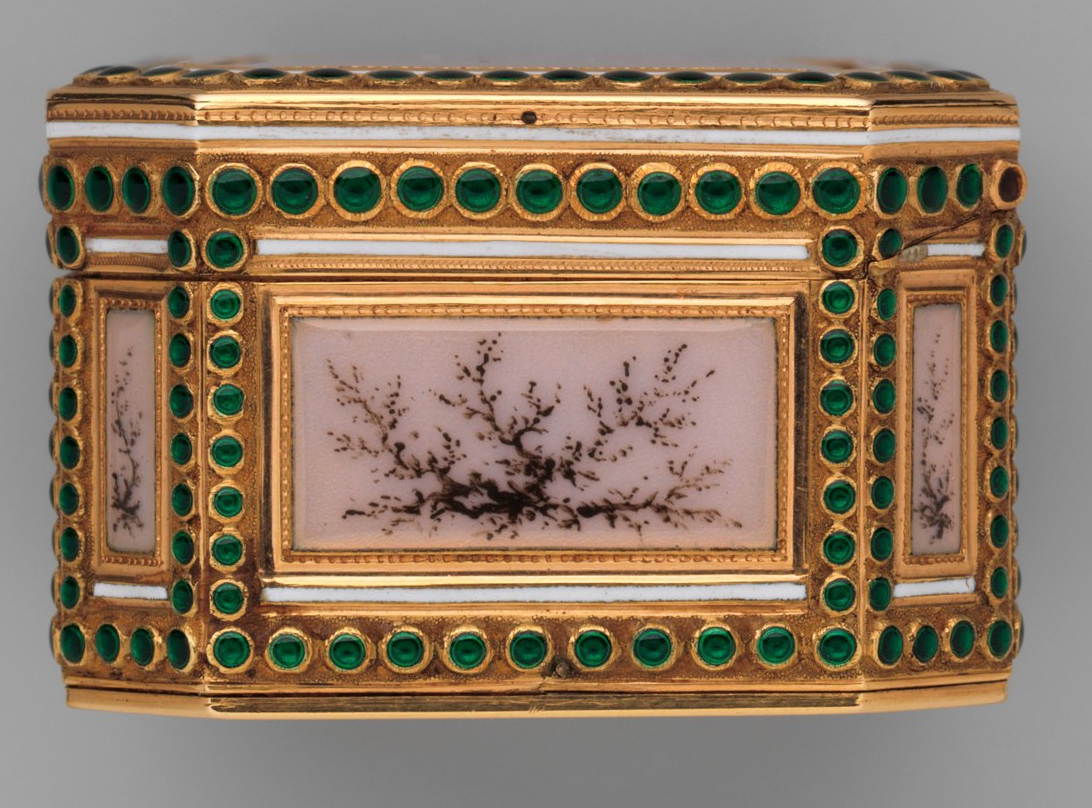
Enamel was an easy option. It could easily replicate the colours and patterns of moss agate exactly to the jeweller’s requirements. This gold snuffbox from 1778-9 is decorated with enamelled panels – the top panel showing scenes from contemporary theatre and the sides are set with pink enamelled patterns with a decoration imitating the plant like inclusions of moss agate. Using enamel allowed the box maker to dictate the size, colour and placement of the patterns and to have matching pieces to go around the box sides.
Imitating a moss agate in glass and paper
In the second half of the eighteenth century, the Parisian printer Louis-Joseph Mondhare came up with an ingenious recipe for making fake moss agate or mocha stone. He described this as ‘a set of new arborisations imitating natural agates, to decorate all sorts of jewels’.
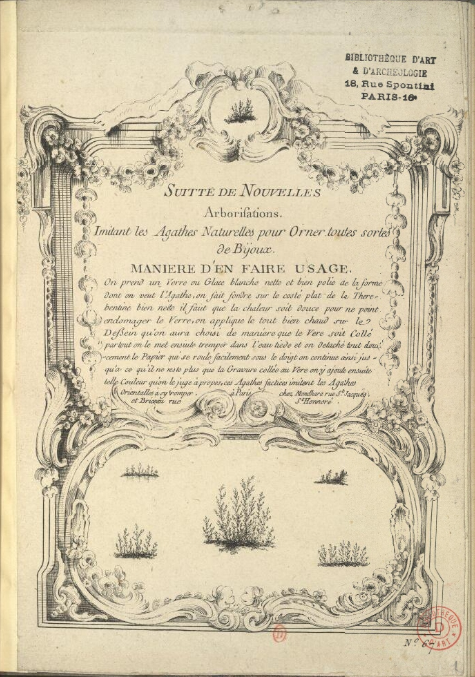
The proposed method was fairly simple:
Take a clean and well polished glass or crystal of the form desired for the agate. Melt turpentine on the flat side, keeping the heat low in order not to damage the glass. Place the treated glass onto the chosen design, ensuring that the glass is completely glued to the paper. Afterwards, soak it in warm water and gently detach the paper which should be easily rolled under the finger, until only the design remains fixed onto the glass. Add any colour considered necessary. These false agates imitate oriental agates to the point of confusion.
Alongside these fairly basic instructions, the printer included two plates of designs to be traced and used as the basis of the fake agate. Sadly, the efficacy and durability of the method remain unknown.
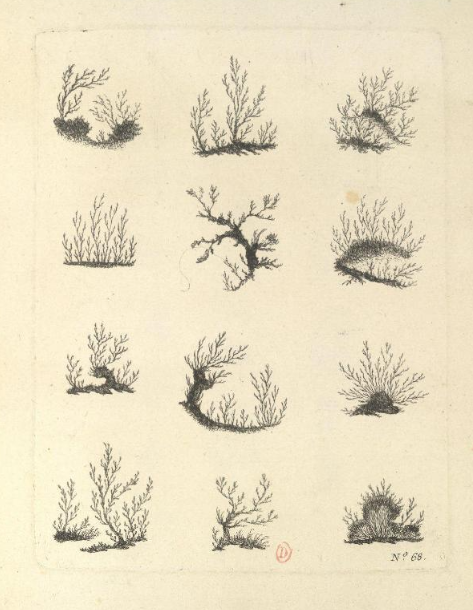
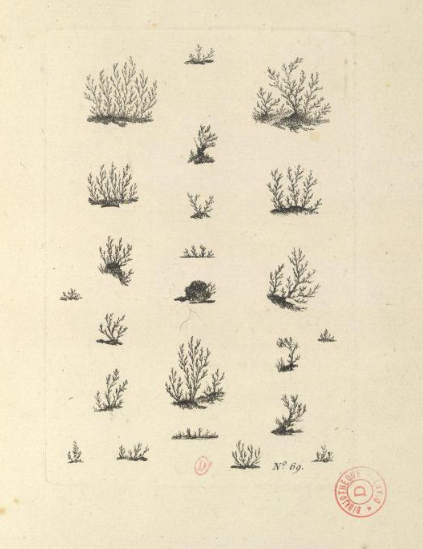
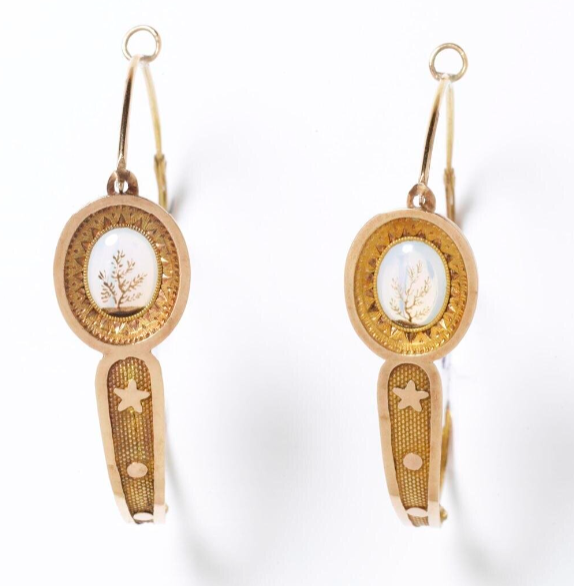
This pair of French earrings was created in the early nineteenth century. The centre panel of each earring is made of opaline paste, a type of glass which was used to imitate opals or moonstones. The reverse of the glass is painted with a simple tree shape, very like some of the designs from Louis-Joseph Mondhare’s earlier book of designs.
Pair of earrings, enamelled gold and opaline glass pastes painted to simulate moss agate, France, mark for South East, 1819-38. Victoria and Albert Museum.
Using hair to fake an agate
Jewellers used hair sentimentally – as part of a love gift, or the relic of a deceased person but it was also ornamental. Strands of hair could be cut and teased into decorative shapes. The delicacy and malleability of hair also made it a good option for imitating moss agates. A very pretty box by Louis Cousin is set with miniatures on ivory, surrounded by panels of imitation moss agate. The dendritic inclusions were simulated with pieces of hair, teased into tree-like shapes.
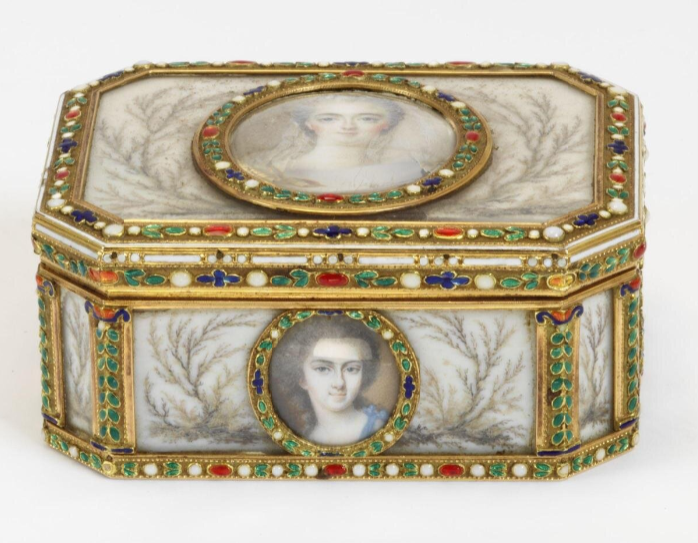
Victoria and Albert Museum
One of the charms of jewellery is the ingenuity of its makers. All sorts of techniques and materials can be pressed into use to make the perfect artistic statement.
Other posts on unusual materials : Making jewellery in a time of war: unusual materials and Jewelled horn: an unexpected material
