The intriguing history of the divorce ring
Traditionally, jewellery goes with weddings and engagements – rings for the new bride, cufflinks or tiepins for the groom, brooches and lockets for bridesmaids. However, the idea of celebrating the end of an union hasn’t had such a long history. Divorce is often a sad affair, the end of a hopeful partnership, but it can also mark a new beginning and why not have appropriate jewellery to mark it?
Divorce jewellery therefore sits on the cusp of two ideas: grief over an ending but sometimes also, optimistic new beginnings.
The early days of divorce
Historically, ending a marriage was a difficult business – famously exemplified by Henry VIII’s attempts to escape his serial marriages. Marriage in a Christian context was intended to last for the lives of the couple – till death do us part – and the grounds for breaking up a union were rather strict. In England and Wales, this required either an annulment (on the grounds that the marriage had never been valid) or a private and expensive Act of Parliament, restricting divorce to a narrow social class. In the nineteenth century, options for divorce in England and Wales began to open up, moving divorce from the church courts to the secular, with the 1857 Matrimonial Causes Act widening the pool of people able to access it.
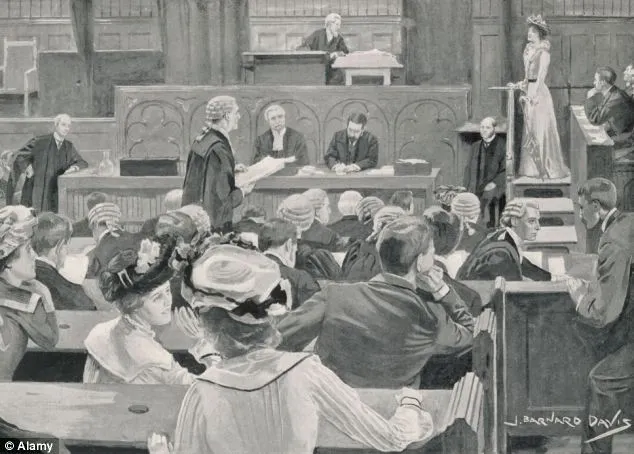
Before 1914, divorce required one of the couple to have committed adultery or to have been violent or cruel and women were very likely to lose custody of their children when divorcing. Divorce also carried a social stigma, particularly for women, and divorced people were unable to remarry in a church.
The first World War and its aftermath saw an increasing number of couples wishing to part, leading to further legal reform in the shape of the 1923 and 1937 Matrimonial Causes Acts. These gave women better legal protection and allowed divorce on the grounds of adultery, cruelty, desertion and incurable insanity. The inability to divorce on the grounds of incurable insanity had kept couples tied together, like the plot of Charlotte Bronte’s novel Jane Eyre while adultery was often proved in court by supplying intimate and sometimes humiliating details.
Divorcing often held a social stigma and early divorce jewellery was sometimes a way to make their social position clear and to avoid uncomfortable conversations about the whereabouts of a missing husband.
Disgracing the New York courts: The early days of divorce rings
Early references to divorce jewellery are comparatively few but increase as divorce became more widespread and accepted. The earliest reference to a divorce ring so far is from 1877 and it was attributed to America. A brief notice in the Weekly Irish Times, Saturday 19 May, 1877 reads:
A divorce ring disgraces the New York courts. It is in opposition to the wedding ring.
This very early divorce ring appears to be a way for a woman to communicate her matrimonial status – like a wedding ring, it told onlookers that she was divorced rather than married or still single.
The next reference is from 1893, again from America. A short newspaper dialogue reads:
“In Chicago:
Mugby- Isn’t it strange that lady should wear an emerald engagement ring?
Rose Budd – It isn’t an engagement ring. You know green means forsaken, don’t you?
Mugby- No; I never knew that.
Rose Budd – Well, it does; and that girl is wearing a divorce ring.”
Toronto Saturday Night, 13 May 1893
This divorce ring is clearly intended to be a sign of loss or grief, the green emerald operating as a sign of forsakenness. This ring, like many early 20th century divorce rings, is like a mourning ring, a sign of grief for a relationship rather than a deceased person.
The divorce ring gains popularity
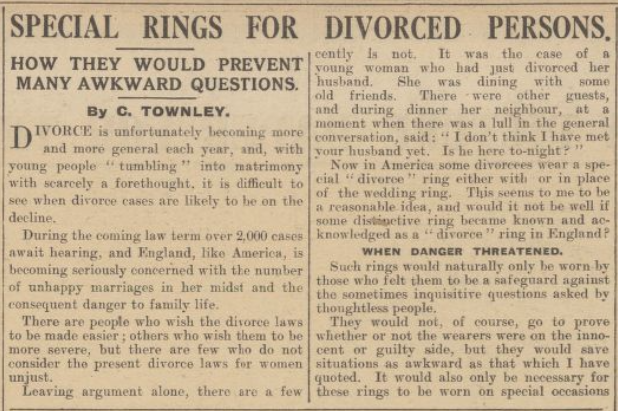
After these rare 19th century mentions, the divorce ring, like divorce itself, grew in popularity in the early twentieth century and began to develop its own visual language. The Daily Mirror approached the problem sympathetically in 1919, noting the growing rate of divorce and the problems which this could cause people. In an article entitled ‘Special rings for divorced persons: how they would prevent many awkward questions’, they put them forwards as ‘a safeguard against the sometimes inquisitive questions asked by thoughtless people.’ (Daily Mirror, 24 September, 1919)
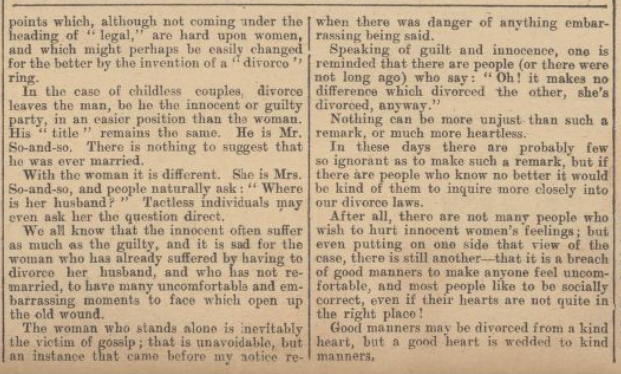
However, the stigma still attached to divorce was thought by some onlookers to make divorce rings unappealing. A letter to the newspapers in 1919 suggested: ‘I cannot conceive of any divorced woman wishing to wear a divorce ring. The world is quite uncharitable enough towards women placed in this position without her desiring to draw more attention to herself’. (Daily MIrror, 29 September 1919)
Nevertheless, divorce rings seem to have been prone to frequent moments of reinvention or rediscovery. Although, they never became mainstream enough to be widely known or worn, they were described as new and intriguing in every decade from the 1910s.
Mrs Marina Parke, the one time wife of the Secretary of the Chicago Board of Traction Engineers, claimed the credit for inventing the divorce ring, despite their earlier appearances.
In 1911, newspapers reported that she was wearing a gold band on her little finger, saying:
‘That’s a divorce ring. I invented it. Pretty soon everybody will know that a plain ring on the right little finger means the wearer is divorced. The divorce ring will save a lot of embarrassment. New acquaintances will not enquire about ‘your husband’ and old friends will not put awkward questions. It is so economical too. The divorced woman can have her wedding ring cut down to fit the little finger.’
However, despite Marina Parke’s hopes, the design and placement of the new divorce ring was far from agreed.
In 1914, it was noted by the Antigua Sun as ‘A divorce ring coming’
‘An English correspondent says that a fashionable jeweller is tentatively launching the new fashion of divorce rings for women. It is thought to fill a felt want. The married woman had her slim golden circlet to warn the amourably intentioned that their efforts were vain. The maiden’s finger was virgin, as presumably her affections. So far it was plain sailing. But what about the divorcee? Well, now she has got her sign manual in the shape of a ring for the index finger of her left hand – a cruciform ring to symbolise that she has been crossed in love.’ Sun (Antigua), 20 March 1914
These new divorce rings were always associated with women and addressed the need to make their matrimonial status clear and unambiguous, particularly for women with children who wanted to avoid the suspicion of having had children outside marriage.
Designing the divorce ring
Like more traditional romantic jewellery, divorce rings aimed to send a message through their design and placement on the hand but there was little consistency in what they should look like.
The design of the divorce ring seems to have been entirely open to interpretation, making surviving examples difficult to identify and the researcher reliant on textual references. In the examples already cited, the divorce ring was set with an emerald to show the forsaken state of the wearer, made in the shape of a cross for ‘crossed love’ and for Marina Parke, her gold wedding ring was cut down and worn on the little finger. However, jewellers, sensing a potential new market, were full of ideas for this new type of jewellery.
Hands turning away
The divorce ring was hailed in 1927 as ‘a novelty in Paris …worn as proudly by a divorced wife as a wedding ring by a bride. On the ring are two microscopic hands set in little diamonds, turned away from each other to signify the rupture with a large stone between the two.’ (Portsmouth Evening News, 1 July 1927). The device of two clasped hands, sometimes known as mani in fede or fede, found on jewellery since antiquity, was deconstructed into this new symbol of rupture.
Broken arrows
In 1922, the Sunderland Daily Echo and Shipping Gazette took an interest, describing them as an American notion ‘of gold, with a device of a broken Cupid’s bow, and stones may be inset – one for each time the wearer has been divorced.’ The Westminster Gazette also reported on it in the same year, though they felt that for serial divorcees ‘a bracelet, or even a necklace, would be more serviceable in some cases, owing to its greater capacity.’
The idea of rupture and the subversion of traditional romantic imagery is also seen in the ‘divorce ring of gold, with a niche containing a broken arrow’. Love jewellery was sometimes made in the shape of an arrow or bow and arrows, representing Cupid, the messenger of love, but for the divorce ring, Cupid’s arrow has been broken into pieces.
The firm making them explained that ‘Divorce rings are made occasionally […] They are worn in place of the wedding-ring by women who have divorced their husbands, but I do not think they will become fashionable in this country. They advertise a woman’s history too much. The idea is American.’ (Berks and Oxon Advertiser, 24 December, 1925).
Clearly the Home Counties were not yet ready for the divorce ring.
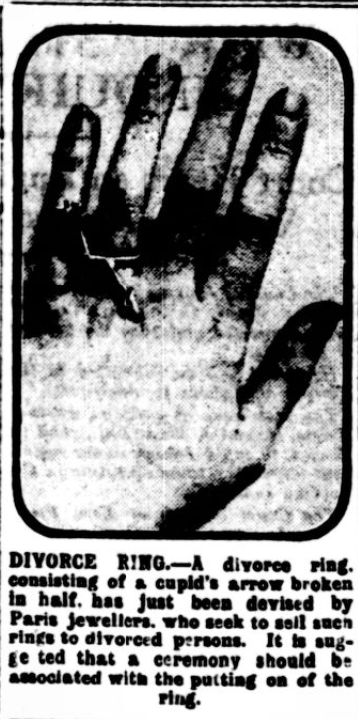
The Daily Herald, 7 April 1925, showed a rare illustration of a divorce ring in the form of a cupid’s arrow broken in half. They suggested that a ‘ceremony should be associated with the putting on of the ring’. Unlike the subtlety of some early divorce rings, this ring would have been impossible to miss and bound to raise questions.
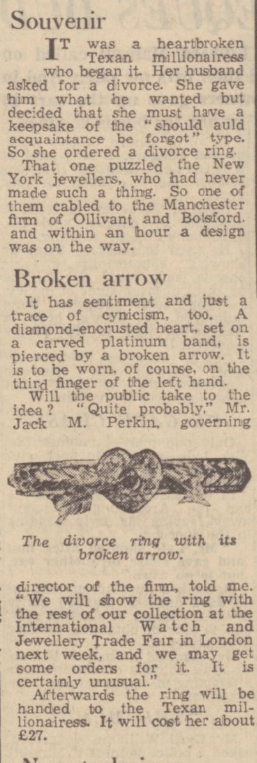
‘Sentiment and just a trace of cynicism, too.’ was the description of a divorce ring for a Texan millionairess in 1955. Looking for a divorce ring, she turned to the Manchester firm of Olifant and Boisford for a ring with a gem encrusted heart pierced by a broken arrow, using the same imagery as the rings from the 1920s.
Manchester Evening News, 26 September 1955
The zig-zag ring
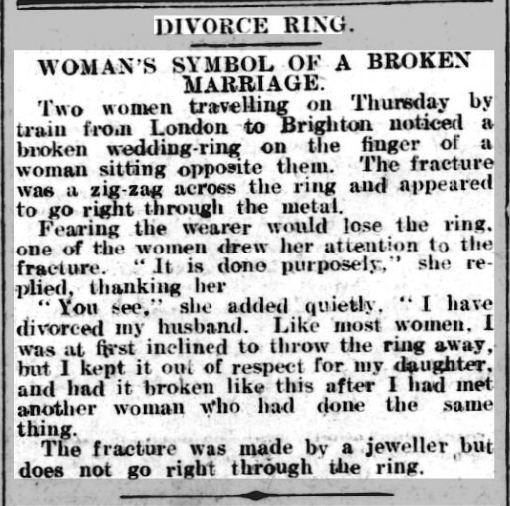
The break up of the marriage was sometimes shown through the physical alteration of the ring. According to the Gloucestershire Echo, 8 September 1922, a woman on the London to Brighton train was spotted wearing a wedding ring with a zig-zag fracture across it. She explained that ‘I have divorced my husband. Like most women, I was at first inclined to throw the ring away, but I kept it out of respect for my daughter and had it broken like this after I had met another woman who had done the same thing.’
Continuing to wear the ring made it clear that her daughter had been born within marriage but the zig zag hinted at the marriage’s end.
Divorce rings as symbols of mourning
The Leeds Mercury of 28 January 1922 also reported on the divorce ring, again attributing it to America. This ring was to be worn as an emblem of ‘their unfettered state’, suggesting an association between divorce and freedom. It was described as ‘a circlet of black pearls set in platinum or oxidised silver and is worn above the plain gold wedding band.’ In this scenario, the wedding ring continued to be worn but was reinterpreted and clarified by the accompanying ring of black pearls or darkened silver, the sombre hue perhaps referring back to the tradition of mourning rings.
Another option, recorded by the Daily Mirror of February 1930, was adding a line of black enamel to the wedding ring, allowing a woman to continue wearing it but amended to make the break up of the marriage clear to onlookers.
Black was also a key element for the rings mentioned by the Daily Mirror on 14 March 1931:
‘Engagement, wedding, and mourning rings have been with us for generations, but the divorce ring is comparatively new. They are having a vogue, I learn, in America, the stone that signifies the broken bond and freedom being black onyx.’
Black onyx, whether natural or artificially dyed, was a popular part of smart Art Deco jewellery and divorcées could feel they were following fashion as well as communicating their new non-marital status.
The Hamilton Observer recorded a more cheerful design, though still retaining the notion of a break or rupture. The design took the form of a traditional eternity ring, broken up by the interruption of a single coloured stone:
‘Consisting of a circle of stones, sometimes diamonds and sometimes pearls, interrupted at one point by a coloured stone, such as an emerald, a ruby or an onyx. The breaking of the circle is, of course, symbolic of the severed marriage union; and in this respect the ‘divorce’ ring may be termed a pathetic emblem. But why pathos should enter into the matter is not very clear: divorced couples are not generally supposed to have any regrets, or, if they have them, to advertise them in this way. Doubtless, the real explanation of the ‘divorce’ ring is simply the expression of a demand for yet another new fashion; and that is all’
20 September, 1930
Reno divorce rings
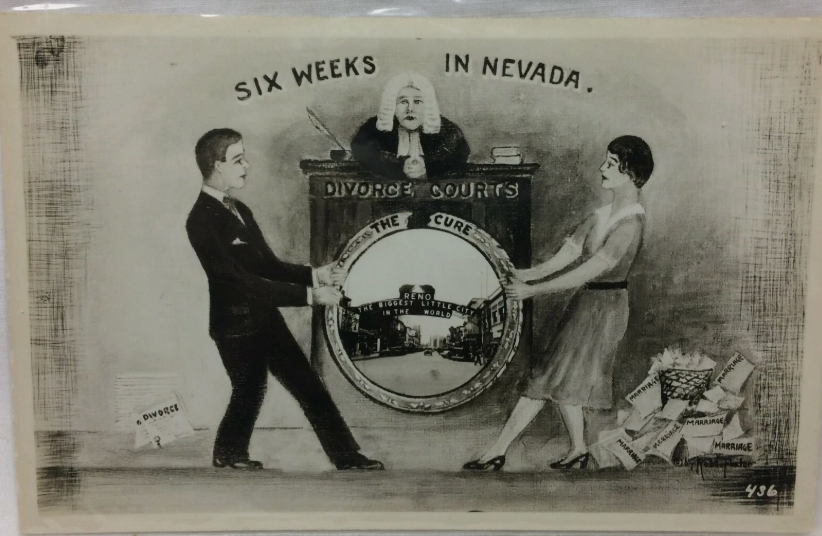
American divorce laws differed from state to state but the easiest place for a woman to obtain a divorce was Reno, Nevada, which became the divorce capital of America. Nevada offered a broad range of grounds for divorce, a short period of required residency (by 1931, this had been cut to six weeks) and allowed divorced people to remarry immediately afterwards – offering Reno jewellers the opportunity to sell wedding rings as well as the new divorce rings. As a consequence, Reno jewellers began to market jewellery to the newly divorced.
‘A “Reno” ring to distinguish divorcees from married women, single women, or widows has been patented and put on the market in America (says Reuter’s New York correspondent: . The ring is a perfectly plain one of black onyx. It is worn on the third finger of the left hand, and inside it, where in America the initials of bride and bridegroom are usually engraved, are the four significant letters ‘Free’.’ Edinburgh Evening News, 29 November 1930
A Reno divorce was, according to this account, a moment of liberation – similar to the alleged custom of divorced women throwing their wedding rings into Reno’s Truckee river. The black onyx might suggest mourning but the inside inscription told another story. https://renodivorcehistory.org
The New Yorker magazine also weighed in on the new divorce ring, with its characteristically wry tone.
‘The newest gadget, and one that might be taken quite seriously at that is the Reno Ring, for that naked wedding finger. This is a band of black enamel (that’s for disillusionment) mounted on platinum, with a little jagged platinum break across it, just like your blighted and broken lives, dears. You can get them at Hickson, Stein & Blaine, Kirkpatrick & Morrell, Saks- Fifth Avenue, and so on. Some of you may need two or three of them, I don’t doubt, with Mexico the way it is.’ (The New Yorker, April 25 1931)
This ring was a clear symbol of heartbreak – black enamel for mourning and a jagged break for ‘blighted and broken lives’. The list of retailers suggests that it was available fairly widely, at least for the smart New York set.
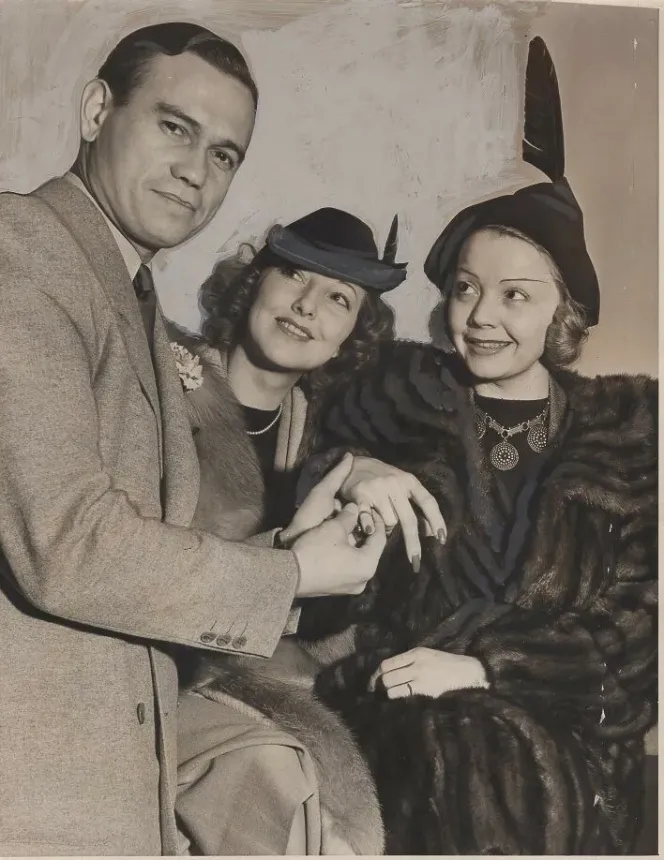
Hollywood star Alice White followed the divorce ring trend when she divorced husband number 2, Sidney Bartlett, in 1938. She put a band of white gold on the little finger of her left hand as a sign of divorce. A photo of her attorney Milt Golden showed him placing the ring on her finger, very much like an engagement ring photograph.
Alice White’s ring was a symbol of her broken marriage but not a discouragement to pursuing love as she married for the third and last time in 1940, although sadly with no more success.
To sum up
Divorce jewellery’s history goes back to 1877 and offers a fascinating insight into changing views of marriage and divorce. Then as now, divorce caused mixed emotions, reflected in the design of divorce jewellery. Some rings communicated a feeling of mourning, through dark colours and sombre imagery. Broken arrows, interrupted circles, hands turning away from each other, took the familiar language of love jewellery and subverted it to send a message about rupture. The break up of the marriage was symbolised through the medium of jewellery – a zig zag cut through the wedding band serving as the most overt example. But, other designs were more celebratory – a ring with the letters FREE inscribed within it, for example, showed the more positive side of divorce. As well as a moment of grief and rupture, it could also be seen as a moment to restart.
See also: modern divorce rings